
Blog · 2026-09-05
How AI Is Changing Smart Homes
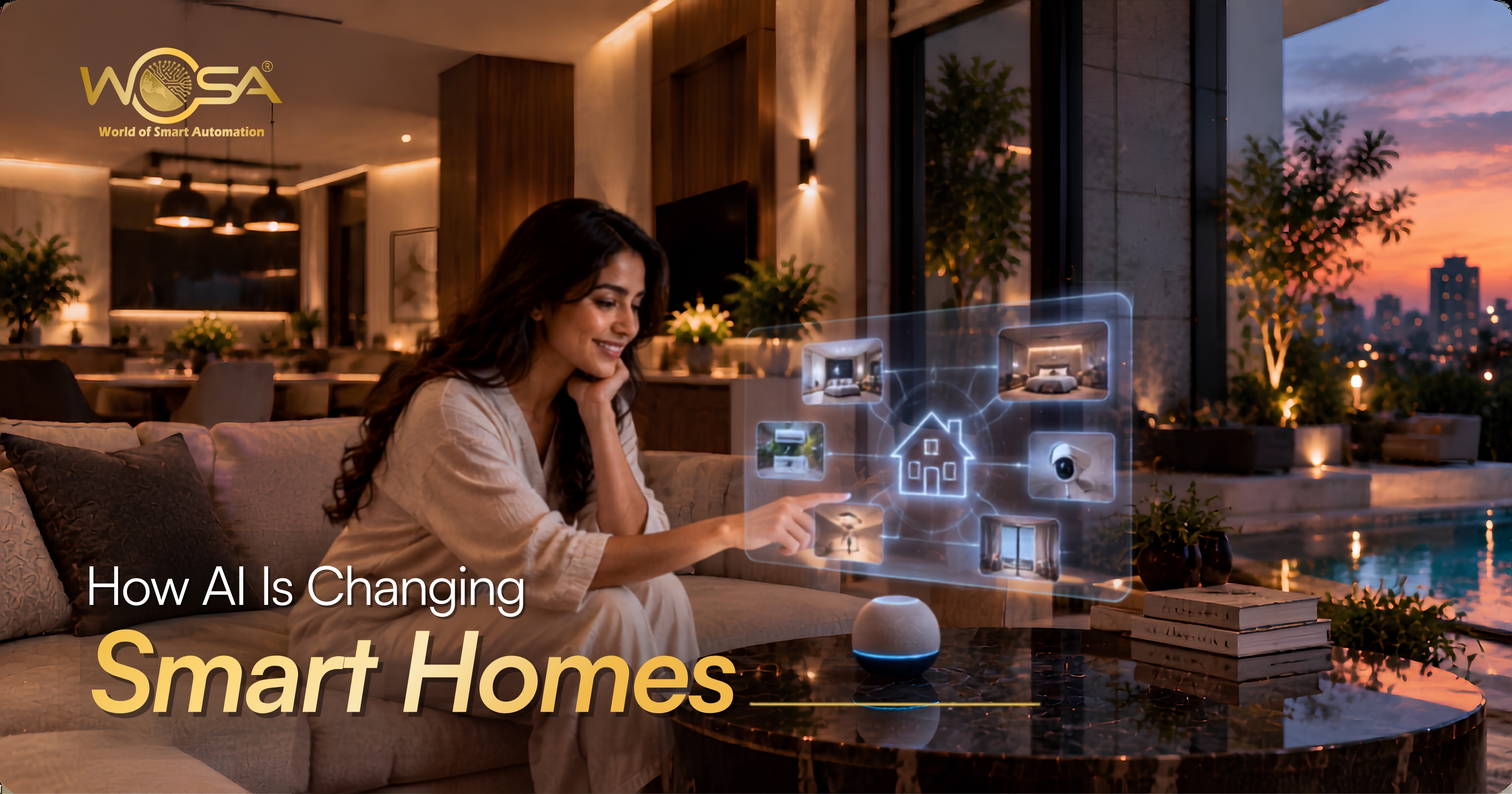
Artificial Intelligence (AI) is taking smart home automation beyond simple app controls and scheduled commands. Instead of simply telling a device what to do, AI can help smart systems understand patterns, respond to changing conditions, and make everyday routines more effortless.
For homeowners investing in smart home automation in Hyderabad, this shift means a home can become more personalized, efficient, secure, and responsive to the way people actually live.
1. Smarter Personalization
AI can analyze routines and preferences to make automation more intuitive. Lighting, temperature, curtains, and entertainment can be adjusted around daily habits instead of relying entirely on manual commands.
2. Intelligent Lighting
AI-powered lighting can use occupancy, schedules, and environmental conditions to create appropriate lighting scenes. WOSA's Lighting Automation Solutions include adaptive lighting, occupancy-based adjustments, daylight tracking, and personalized scenes.
3. Predictive Comfort
AI can help connected climate systems respond to usage patterns and changing conditions. This can make rooms more comfortable while reducing unnecessary operation of connected equipment.
4. Smarter Home Security
AI-based CCTV and security systems can analyze activity and provide more meaningful alerts. WOSA offers AI-based CCTV and security solutions as part of its integrated smart-home portfolio.
5. Better Energy Management
AI can identify patterns in household energy consumption and help optimize when connected devices operate. Research into AI-enabled home energy management is increasingly focused on forecasting, scheduling, and energy optimization.
6. More Natural Voice Control
AI is also making voice interaction more conversational. Rather than remembering multiple commands, homeowners can increasingly interact with connected systems using natural language.
7. Connected Home Experiences
The real advantage comes when AI works across multiple systems. Lighting, security, climate, curtains, entertainment, and access control can operate as one connected ecosystem. WOSA focuses on this integrated approach rather than treating every smart device as a separate system.
8. Automation That Adapts
Traditional automation follows fixed rules. AI can help systems become more responsive by recognizing patterns and adapting automation to changing routines.
What Does the Future of AI Smart Homes Look Like?
The future is moving toward homes that are not only connected but context-aware. AI can become the intelligence layer that helps different smart-home technologies work together more naturally.
For homeowners considering AI smart home automation in Hyderabad, professional planning is important. WOSA provides design, installation, integration, and ongoing support for connected home solutions.
Explore WOSA's Home Automation Solutions to discover how intelligent lighting, security, climate, entertainment, and scene control can work together.
Frequently Asked Questions
How is AI changing smart homes?
AI is making smart homes more adaptive by analyzing patterns, improving automation, supporting intelligent security, optimizing energy use, and enabling more natural interactions.
Can AI control home lighting and climate?
Yes. When compatible systems are integrated, AI can use factors such as occupancy, schedules, and usage patterns to make lighting and climate control more responsive.
Is AI useful for home security?
Yes. AI-based cameras and analytics can help identify activity and generate more relevant security alerts.
Is AI smart home automation available in Hyderabad?
Yes. Homeowners can work with professional automation integrators to design AI-enabled and connected smart-home systems based on their property's requirements.